
Field brief — the short answer
Snug, not tight. Measure where the brand tells you to (for example, the widest part of the chest for Salomon, or the bottom of the sternum for Nathan), choose a size from that brand’s chart, then load the vest and adjust it. [2][3] If the straps sit near the middle of their range and nothing bounces, the size is right. [1]
Should a running vest be tight or loose?
Tight-ish. Running vests are meant to fit quite snug, so they don’t shift around while you run. [1] A vest that is too big moves with every stride, which is distracting and can cause painful chafing. [1] The opposite failure matters just as much: if the vest feels restrictive when you take a deep breath, like you will on a steep climb, it is probably too small. [1]
A useful way to picture the right fit: the vest should feel like it is part of your torso, with even contact across your shoulders, ribs and back, and no single strap doing all the work. You should be able to breathe all the way in without the chest straps biting.
Two quick self-checks capture most of it:
- Snug enough: with the vest loaded, a few hard strides don’t make it bounce or slide.
- Not too tight: a full, deep breath doesn’t feel restricted, and the straps don’t leave pressure points. [1]
How to size a running vest
Start with the manufacturer’s chart for the exact vest you’re considering. Brands base sizing on different body measurements, such as bust, sternum or ribcage circumference, and their guidelines vary. [1] That is the single most common sizing mistake: measuring once and assuming a “medium” means the same thing everywhere.
How to measure. Use a soft tape, stand relaxed with your arms down, keep the tape level, and breathe normally. Take two numbers so you’re ready for any chart:
- Chest at its widest point, measured horizontally. This is what Salomon uses. [2]
- Circumference at the bottom of your sternum, the point where your ribs start to flare. This is what Nathan uses for its unisex race vest. [3] Ultimate Direction lists both a chest range and a lower-rib range. [4]
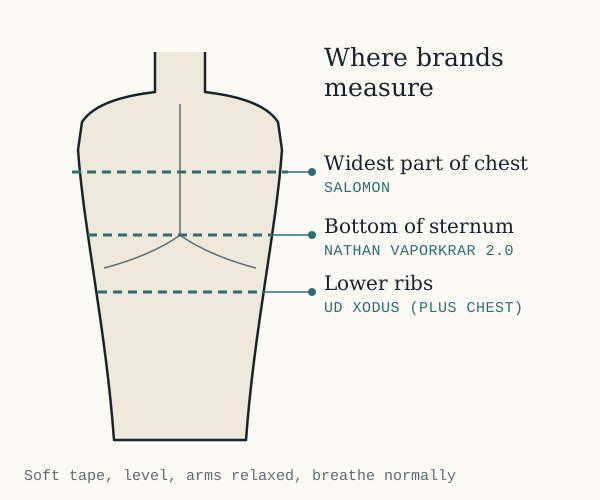
| Brand and model | Where to measure | Size ranges (official chart) |
|---|---|---|
| Salomon unisex hydration vests | Chest, horizontally at the widest point [2] | XXS 80–85 cm · XS 85–91 · S 91–97 · M 97–103 · L 103–109 · XL 109–118 [2] |
| Nathan VaporKrar 2.0 (unisex) | Bottom of the sternum, arms relaxed at your sides [3] | XS 33–35 in · S 36–38 · M 39–41 · L 42–44 · XL 45–47 [3] |
| Ultimate Direction Xodus Vest | Chest and lower ribs [4] | SM chest 31–36 in (80–91 cm) · MD 35–39 in (89–100 cm) · LG 38–43 in (97–110 cm) · XL 43–47 in (110–120 cm) [4] |
Size labels don’t transfer between brands. A runner with a 95 cm (37.4 in) chest falls in Salomon’s S (91–97 cm) but Ultimate Direction’s MD (89–100 cm). [2][4] And because Nathan measures at the bottom of the sternum, a point usually smaller than the widest part of the chest, that runner needs a second measurement before choosing a Nathan size. [3]
If you fall between sizes, don’t guess from the label. Choose the size that puts the adjustment straps near the middle of their range when you wear the layers you usually run in. If the straps end up at one extreme or the other, you likely have the wrong size. [1]
How to put on and adjust a running vest, step by step
Fit a vest the way you’ll actually use it, with weight in it. REI recommends loading a vest with weight when trying it on to get the most accurate feel. [1]
- Load it. Fill the flasks or reservoir with water and pack what you normally carry: a jacket, phone and food. An empty vest fits differently from a full one.
- Loosen every strap before you put it on, so you’re not fighting old settings.
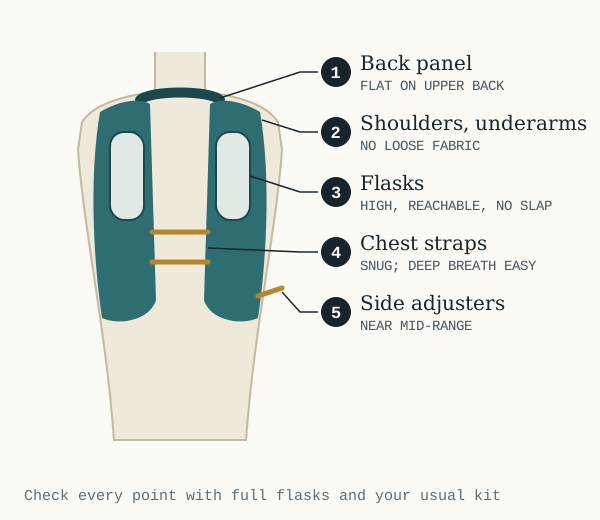
- Put it on like a vest and let the back panel settle flat against your upper back.
- Close the front. Clip or hook the chest straps loosely, or zip the front if your vest uses a zipper.
- Tighten the side or underarm adjusters evenly, left and right, until the back panel stops moving when you twist your torso.
- Snug the chest straps last, just enough to hold the front panels in place. Then take a deep breath to check you’re not restricted. [1]
- Check the adjustment range. Every strap should sit roughly mid-range. If one is maxed out or barely tightened, consider another size. [1]
- Check your reach. Make sure you can pull a flask, grab a gel and reach your phone pocket without stopping. Pocket position matters as much as fit. [1]
The full-load bounce test
Once it’s adjusted, test it before your first long run:
- Jog in place for 30 seconds.
- Do ten small hops.
- Run down a few stairs or a short slope. Downhills reveal bounce that flat ground hides.
- Swing your arms hard, as you would on a climb.
- Stop and take three deep breaths.
Watch and feel for the problems below. Most can be fixed with adjustments; some mean the size is wrong.
| What you notice | Likely cause | What to try first |
|---|---|---|
| The whole vest bounces or slides up | Straps too loose, or vest too big | Tighten the side adjusters. If they’re already at the end of their range, try a smaller size. [1] |
| Loose fabric at the shoulders or under the arms | Vest too big | Try a smaller size. [1] |
| Breathing feels restricted on deep breaths | Chest straps too tight, or vest too small | Loosen the chest straps a little. If it’s still restrictive, try a larger size. [1] |
| A strap sits at either end of its range | Wrong size for your build | Try the next size in the direction the strap points. [1] |
| Rubbing or hot spots | Movement against the skin, usually from a vest that’s too big or loosely adjusted | Re-adjust for a snugger fit; recheck the size. [1] |
| A reservoir sloshes on your back | Air trapped in the reservoir | After filling, turn the vest upside down and suck air out through the tube. [1] |
Signs your running vest is too big, or too small
Too big:
- It shifts or bounces even after you tighten it. [1]
- There’s excess fabric around the shoulders or where the vest wraps under your arms. [1]
- The adjusters are cinched to the end of their range. [1]
- You notice chafing in places that only rub when the vest moves. [1]
Too small:
Women’s running vest fit
Many women benefit from a women-specific vest. These typically have more room in the bust, narrower shoulders and a shorter overall cut than unisex models. [1] Sizing works the same way: measure where that brand’s chart tells you to, and check whether it uses bust, sternum or ribcage circumference, because the charts differ. [1]
During the bounce test, pay particular attention to where the chest straps cross. Many vests let you slide the straps up or down. Set them where they stay put without pressing on the bust, then recheck that a deep breath feels comfortable.
What size vest for what distance?
“Size” also means capacity, measured in liters. How much you need depends mostly on how long you run. REI suggests this starting point: [1]
| Run duration | Suggested vest capacity | What typically goes in |
|---|---|---|
| Under 1 hour | Often no vest; a handheld bottle or small waist pack [1] | Water, key, a gel |
| 1–2 hours | About 2 liters [1] | More water and food, plus a phone and a light layer [1] |
| 2–3 hours | 2–6 liters [1] | Add a hat and gloves, a headlamp, and a first-aid kit and map for remote routes [1] |
| 3–6 hours | 4–12 liters [1] | Refills, more food and a rain shell |
| 6+ hours | 6 liters or more [1] | Full kit for changing weather |
Two details help you choose within those ranges.
Water. REI’s general guide is to drink about 5–10 fl oz every 15–20 minutes, adjusted for heat and how often you can refill. [1] Race rules can set the floor for you. For example, ZUT100 requires sealable water containers with a total capacity of at least 1.5 liters, plus a waterproof jacket with taped seams and other mandatory gear, all of which has to fit. [5] If you plan to race, check the kit list before you choose a capacity. Our rain shell vs wind shell guide covers the jacket side of that list.
One vest or two. If your runs vary a lot in length, one vest large enough for your longest outings is practical. But excess empty space can make a vest move more on short runs. [1] Tighten it down, or consider a smaller second vest if bounce on short runs bothers you.
Bottles, soft flasks or a reservoir?
Most vests are designed to carry front bottles and a back reservoir, often at the same time. [1] The trade-offs: [1]
| Front bottles / soft flasks | Back reservoir | |
|---|---|---|
| Refilling | Faster and easier mid-run | Slower; you have to remove it |
| Capacity | Smaller | Generally more water |
| Tracking intake | Easy to see what’s left | Hidden on your back |
| Mixing drinks | Easy: water in one, electrolytes in the other | One liquid only |
| Drawbacks | Soft flasks can puncture in a fall | Weight on your back; can slosh unless you remove the air |
Some vests ship with bottles or a reservoir and some don’t, so check what’s included before buying. [1] The Ultimate Direction Xodus, for example, includes two 500 ml soft flasks and accepts a reservoir of up to 1.5 L. [4]
Features to check before you buy
- Pocket placement: can you reach your phone, food and jacket without stopping? [1]
- Pocket closures: zippers keep valuables secure in a stumble, while stretch pockets are faster to use. [1]
- Breathability: look for mesh on the back panel and straps if you run hot. [1]
- Reflectivity for dawn, dusk and road sections. [1]
- Emergency whistle, often on a sternum strap. [1]
- Pole keepers if you use trekking poles on steep races. [1]
Capacity and features vary widely between models, so compare the specs of the exact vest and size you’re considering.
When not to buy yet
Wait if you fall between sizes and can’t try the vest with a full load. Fit with weight is the only reliable test, and strap position is your best sizing signal. [1] And if most of your runs last under an hour, do not buy a vest just yet: a handheld bottle or a small waist pack may be all you need. [1]
Sources
Sources
- How to Choose a Running Hydration Vest — REI Co-op; accessed 2026-10-03
- Size guide: Unisex’s Hydration Vests — Salomon; accessed 2026-10-03
- Size Chart VaporKrar 2.0 Unisex — Nathan Sports; accessed 2026-10-03
- Xodus Vest — Ultimate Direction; accessed 2026-10-03
- Mandatory Gear (ZUT100) — Zugspitz Ultratrail by UTMB; accessed 2026-10-03
Common questions
Common questions
The details people ask before they go.
How do you know if a hydration vest is too big?
It shifts or bounces even after you tighten it, there’s loose fabric around the shoulders or under the arms, or the adjusters are cinched to the end of their range. [1]
How tight should a running vest be?
Snug enough that it doesn’t move while you run, but loose enough that a deep breath doesn’t feel restricted. [1]
What size hydration vest do I need?
Measure where that brand’s chart specifies, such as the widest part of the chest for Salomon or the bottom of the sternum for Nathan, and choose from that chart. Size labels don’t transfer between brands. [2][3]
How do you wear a running vest?
Load it, loosen all the straps, put it on, tighten the side adjusters evenly, then snug the chest straps. The straps should end up near the middle of their range. [1]
What distance do you need a running vest for?
Many runners start using a vest for runs of about 1–2 hours or longer. For shorter runs, a handheld bottle or waist pack is often enough. [1]
Related notes