
Field brief — the short answer
A wind shell is a featherweight, water-resistant layer that blocks wind and sheds a brief drizzle; a rain shell is a seam-taped waterproof barrier built for sustained or wind-driven rain. [1] If rain is likely to last, or cool, wet, windy weather is possible on your route, carry the rain shell. [1][2]
The short difference
The two jackets look similar on a hook, but they are built for different jobs.
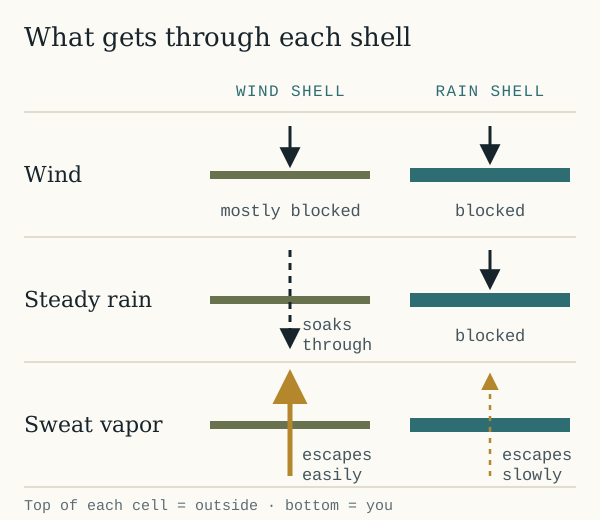
A rain shell is waterproof: its water resistance is high enough to keep out driving rain. [1] To earn that label it has to be fully seam-taped, because rain finds its way through stitching holes. [1] For hiking, you want a waterproof/breathable shell, which blocks rain while letting sweat vapor escape, because both rain and your own sweat can soak you. [1]
A wind shell (often called a windbreaker or wind shirt) is water-resistant, not waterproof. It can handle light rain for a short time, but it won’t keep up if precipitation lingers or starts coming down sideways. [1] What it does well is block wind while weighing almost nothing. Patagonia’s Houdini, a common reference point for this category, weighs 105 g (3.7 oz), uses ripstop nylon with a durable water repellent (DWR) finish to resist light moisture, and packs into its own chest pocket. [3]
One fact surprises people: any waterproof jacket is also windproof. A barrier that stops driving rain also stops the wind pushing it. [1] So a rain shell can stand in for a wind shell. A wind shell cannot stand in for a rain shell.
Side-by-side comparison
| Wind shell | Rain shell | |
|---|---|---|
| Main job | Block wind; shed a brief drizzle [1] | Keep out sustained and wind-driven rain [1] |
| Water protection | Water-resistant: light rain for a short time [1] | Waterproof, with fully taped seams [1] |
| Wind protection | Wind-resistant to windproof, depending on fabric [1] | Windproof [1] |
| Breathability | Generally high. Sweat escapes easily, so it suits hard efforts. | Lower. Depends on the membrane; pit zips help dump heat. [1] |
| Example weight | Patagonia Houdini: 105 g / 3.7 oz [3] | Patagonia Torrentshell 3L: 400 g / 14.1 oz [4] |
| Packability | Stuffs into its own chest pocket [3] | Stuffs into a handwarmer pocket [4] |
| Best for | Breezy ridgelines, cool starts, fast hikes and runs in a dry forecast | Forecast rain, long or remote days, cold and wet conditions |
The weight gap is the real trade-off. In this example the rain shell is nearly four times heavier and noticeably bulkier, which is why many hikers carry a wind shell for everyday use and keep the rain shell for days when the forecast or the route demands it. [3][4]
What a rain shell actually does
A rain shell depends on a membrane or coating that blocks liquid water while letting sweat vapor pass outward. [1] Two construction details explain most of the price and performance differences.
Laminate or coating. A laminate bonds a membrane to the face fabric, like wallpaper glued to a wall. A coating is spread on, like paint. Laminates are generally better for waterproofing, breathability and durability, and they cost more. Coatings are cheaper and can be lighter. [1]
Layer construction. REI summarizes the three common builds this way: [1]
| Construction | Waterproofing | Breathability | Durability | Weight | Price |
|---|---|---|---|---|---|
| 2-layer | Good | Good | Better | Midweight | Moderate |
| 2.5-layer | Good | Good | Good | Ultralight to light | Lowest |
| 3-layer | Best | Best | Best | Lightweight | Highest |
As a concrete example, the Torrentshell 3L referenced above is a 3-layer jacket with venting pit zips. [4]
What about the “mm” waterproof rating? Some brands publish a water-column number in millimeters. Treat it as a rough guide only, because companies disagree on test standards. [1] For a real-world benchmark, look at mountain-race kit rules. The ZUT100 race at Zugspitz Ultratrail by UTMB requires a waterproof jacket with taped seams and at least a 10,000 mm water column. [5]
Breathability claims are even harder to compare. There is no universal test standard or independent certification body for breathability. [1] That is why vents matter: pit zips, mesh-backed pockets, and adjustable cuffs and hem let you release heat that even a good membrane can’t move fast enough during a hard climb. [1]
What a wind shell actually does
A wind shell is a thin, tightly woven layer whose main job is to cut the chilling effect of moving air. Because it doesn’t need a waterproof membrane or taped seams, it can be extremely light and packable. [1][3]
That simplicity makes it useful in conditions a rain shell handles badly. On a steep climb in a cool breeze, a rain shell can trap enough sweat to soak your base layer from the inside. A wind shell blocks the breeze while letting most of that moisture out. Its DWR finish will bead off a passing sprinkle, but once rain is steady the fabric will wet through. [1][3]
Use a wind shell when:
- The forecast is dry, but you expect wind on ridges, summits or open ground.
- You start early, cold and fast, and will warm up within the first half hour.
- You are trail running or fast hiking and will sweat heavily.
- You want a “just in case” layer that weighs less than most smartphones. [3]
Which shell performs in sustained rain?
Only a rain shell: a waterproof, fully seam-taped jacket. [1] A water-resistant wind shell is designed for short, light rain and will be overwhelmed when precipitation lingers. [1]
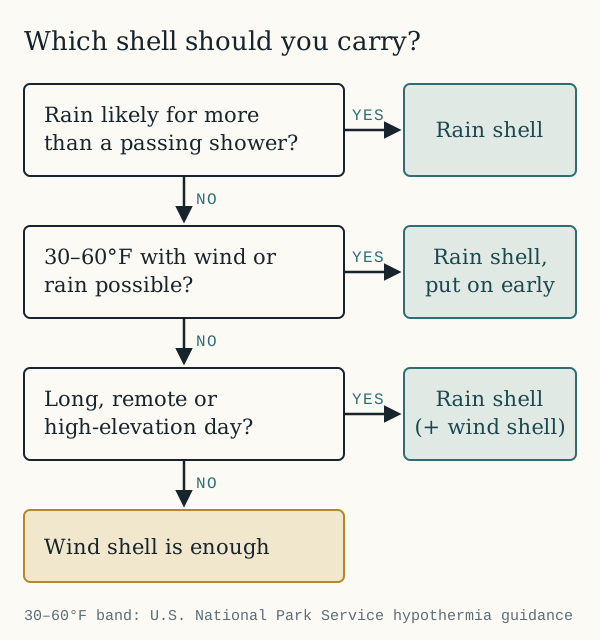
This matters for safety, not just comfort. The U.S. National Park Service warns that hypothermia can develop at air temperatures between 30 and 60°F (about −1 to 16°C), especially with wind or rain. Its advice is to put on rainwear or warm clothes before you become soaked or cold. [2] A wet wind shell in a cold breeze is exactly the combination to avoid.
In long rain, also expect even a good rain shell to feel damp inside. When the face fabric’s DWR wears down, the outer fabric absorbs water, breathability drops, and condensation can form inside. That can feel like a leak even when the membrane is still keeping rain out. [1][6] The fix is maintenance, covered below.
How to decide from the forecast
Start with what the forecast actually says. The U.S. National Weather Service defines probability of precipitation (PoP) as the chance that a given forecast point will receive at least 0.01 inch of rain. [7] A “40% chance of rain” therefore tells you nothing about how hard or how long it might rain, so read the hourly forecast and the wind forecast as well.
Then use this as a starting point:
| Conditions on your route | Carry |
|---|---|
| Dry forecast, breezy or exposed | Wind shell |
| Warm, short route, brief showers possible, easy bail-out | Wind shell (accepting you may get damp) |
| Rain likely for more than a passing shower | Rain shell [1] |
| Temperatures 30–60°F with wind or rain possible | Rain shell, put on early [2] |
| Long, remote or high-elevation day | Rain shell; add the wind shell if you will be working hard in wind |
| Race or event with a mandatory kit list | Rain shell that meets the organizer’s spec, e.g. taped seams and ≥10,000 mm at ZUT100 [5] |
When to carry both
On long days with mixed weather, carrying both is often the most comfortable choice. Wear the wind shell for most of the day, when wind and effort are high and rain is light or absent, and keep the rain shell in reserve for steady rain or long stops in cold wind.
The weight cost is easy to calculate. Using the two examples above, the pair adds about 505 g (17.8 oz). [3][4] If that is too much for your trip, the rain shell is the one to keep, because it can do both jobs and the wind shell can’t. [1]
If you are building a full clothing system, see our guide to layering for day hikes. For where the shell lives in your pack, see choosing a day-hiking pack.
Keep your rain shell working: DWR care
Most rain shells that seem to “stop working” have a worn DWR finish, not a failed membrane. [6] Dirt, sweat, sunscreen and body oils clog the finish over time. Once rain stops beading on the surface, the face fabric wets out. [1]
To restore it, follow the care label first, then this general routine from REI’s GORE-TEX care guidance: [6]
- Machine wash in warm water with a small amount of liquid detergent or a technical cleaner. Avoid powder detergent, fabric softener and bleach. [6]
- Rinse twice so no detergent residue is left behind. [6]
- Hang dry or tumble dry on a warm, gentle cycle, as the label allows. [6]
- Once dry, tumble for another 20 minutes on medium heat to revive the DWR. If the label says hang dry only, use a warm (not hot) iron with no steam and a thin cloth between the iron and the jacket. [6]
If water still soaks into the face fabric after washing, apply a spray-on or wash-in DWR treatment, then heat-activate it the same way. [6]
When not to buy yet
Wait before replacing a rain shell that “leaks” only after long use. Wash it and revive or re-treat the DWR first, because a worn finish is often mistaken for membrane failure. [6]
Do not buy a wind shell expecting it to replace a rain shell on long, wet or cold days; it is designed only for light rain for a short time. [1] And if your hikes are short, fair-weather loops close to the trailhead, the rain shell you already own can block wind too, so you may not need a second jacket at all. [1]
Sources
Sources
- Rain Gear: How to Choose the Best Rain Jacket — REI Co-op; accessed 2026-10-03
- Hypothermia — U.S. National Park Service, Wrangell–St. Elias; accessed 2026-10-03
- Men’s Houdini Jacket — Patagonia; accessed 2026-10-03
- Men’s Torrentshell 3L Rain Jacket — Patagonia; accessed 2026-10-03
- Mandatory Gear (ZUT100) — Zugspitz Ultratrail by UTMB; accessed 2026-10-03
- Rainwear: Washing & Caring for GORE-TEX — REI Co-op; accessed 2026-10-03
- FAQ – What is the Meaning of PoP — National Weather Service, Peachtree City GA; accessed 2026-10-03
Common questions
Common questions
The details people ask before they go.
Is a wind shell waterproof?
No. A wind shell is water-resistant: its DWR finish sheds light moisture for a short time, but steady or sideways rain will soak through. [1][3]
Is a rain jacket also windproof?
Yes. Any waterproof jacket is also windproof, because a barrier that keeps out driving rain also stops the wind. [1]
What shell performs in sustained rain?
A waterproof, fully seam-taped rain shell. Among common constructions, 3-layer shells are generally the most durable and breathable, and 2.5-layer shells are the lightest. [1]
What waterproof rating should I look for?
Brands test differently, so compare mm ratings loosely. [1] Mountain race rules are a useful benchmark: ZUT100 requires taped seams and at least a 10,000 mm water column. [5]
Why does my rain jacket feel wet inside?
Usually because the DWR has worn off. The outer fabric absorbs water, breathability drops and condensation forms inside, which feels like a leak. Washing and reviving the DWR usually helps. [6]
Related notes